Literature across the curriculum – initial thoughts

In my first year teaching, many years ago, I worked at Rutherford High School in New Zealand. One of the subjects I taught was called Humanities – that was a posh name for ‘Social Studies’. I particularly loved the curriculum they had then at Rutherford High. Each unit had about four or five novels (with multiple copies of the titles) linked with it. One unit was on Industrialism and there were some great novels linked with it set in Victorian times showing the impact of this phenomena on society through story. The students were expected to read at least one of the associated novels, more if they wanted to. They kept a reading log and were invited to complete a reading response. I found this way of teaching a particular period or concept in the Humanities curriculum very empowering. The students not only had the opportunity to learn facts, skills and concepts linked with Social sciences they had them come alive in their imaginations as they read story. When I saw the title of this course I immediately though of that curriculum and the success I felt it had for my student’s learning.

Many years later I am working in a school that runs all three programmes of the International Baccalaureate.  The Primary Years Programme which is for children age 3 – 12 is Inquiry based and in my role as librarian I bring literature links to the units of Inquiry as well as Information literacy links. Our students come from a range of cultures and backgrounds and many of them have English as their second language. We use picture books and stories to proved links with curriculum. This often also helps students develop vocabulary and concepts around the unit. An example of this is our students in Prep (age 5) were Inquiry into water. We used the story Rain School by James Rumford to show how rain can be destructive in some communities. The story is set in Chad and the children have to make their school from mud bricks. Their first lessons are how to build the school. They then learn how to read and write over the next few months until the end of the school year. Then the rains come and wash away the entire school building. This really captures their imaginations and we begin to use vocabulary like floods, monsoon, and develop some of the degrees of rain as well, showers, deluge and so on.

I am hoping that this course will enable me to understand the value of literature for children’s learning and develop strategies to help my colleagues at Istanbul International Community school to integrate literature in their curriculum areas.

References

Rumford, J. (2010). Rain School. Retrieved November 16, 2014, from James Rumford website: http://jamesrumford.com/jamesrumford.com/Rain_School.html

Rumford, J. (2010). Rain school. Boston: Houghton Mifflin Books for Children.
Resourcing the curriculum – once a year

lib team

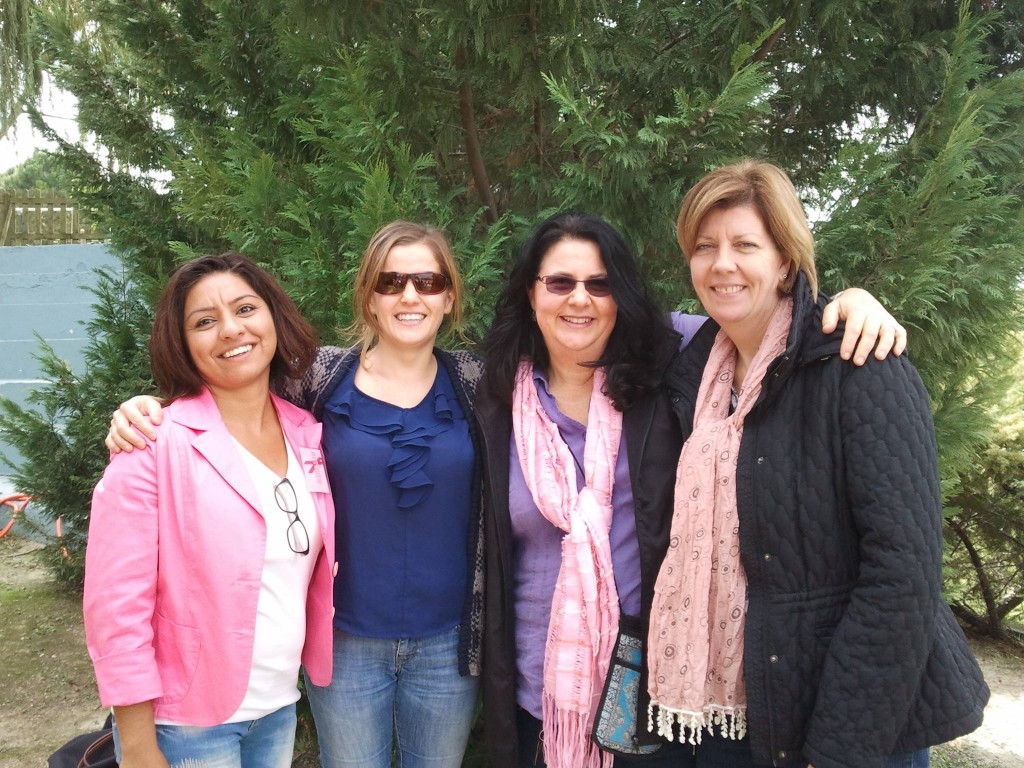
The IICS library team 2014.

I am teacher librarian at Istanbul International Community School in Turkey. I have been working here since August 2009 so almost five years now. It is my first experience working in an international school. I came to Turkey having worked all my career in New Zealand secondary schools, most recently as teacher librarian at Takapuna Grammar School.

In Turkey we have very strict customs controls and it is very hard to import classroom materials and books in English language. As a result our school has one ordering period each year – November and one bulk order delivery each year – August. So in my first months in Turkey, while adjusting to  a new school, an expanded library area, running libraries over two campuses, new curriculum, teaching primary and pre-school, living in the largest city in the country – I was asked to order ALL the library books, e-resources and library materials we would need for the following year. It was a daunting task. I started the task by consulting with my colleagues and completing a quick survey of the collection in both libraries.

Since that experience of being thrown in the deep end I developed some methods of wish listing throughout the year so I can at least be responsive to staff and student suggestions. I have convinced the administration to allow me some budget for ‘local purchasing’ so I can purchase throughout the year. We have a better way to consult with staff and students about their needs but it needs to improve and deepen. We have a wonderful librarians’ network here in Istanbul with 30 colleagues from international and Turkish private schools sharing ideas – we all face this situation with ordering and collection development. I have learned so much from our network meetings held three times a year.

I am looking forward to participating in this course as I know it will help me to: evaluate the resources we have in the library right now, develop ways to ensure we have student and staff voice in our purchasing decisions, think carefully about how develop our mother tongue collection so the indigenous writers of each culture are represented, expand our electronic resources. There is so much to learn.

Teacher librarians and the curriculum – some thoughts

I work in an International School in Istanbul. We run three International Baccalaureate (IB) programmes – the Primary Years Programme (PYP) 3 – 12 years old, The Middle Years Programme (MYP) 13 – 16 years old and the final two years the Diploma Programme (DP) 17 – 18 years old.. So our school pedagogical perspective is founded in the IB programmes. I am new to the IB and over the past four years I have been learning about the programmes.

The PYP programme is the one that has most links with Inquiry learning. In fact the IB website states that this is the intended goal of the programme. (“International Baccalaureate: Four Programmes,” n.d.) I feel very fortunate that as part of the Inquiry process our school provides whole days for each grade level to plan together every six weeks. The team comes together the plan the next unit of Inquiry and evaluate and reflect on the one just coming to an end. I am invited to each planning day and while I usually do not spend the whole day with my colleagues I certainly do spend at least 30 minutes with them working on resourcing, skills development. evaluation tools. Below is a gallery of some of the planning that happened last year on a Professional Development day on Inquiry Learning with Kath Murdoch, an expert on Inquiry Learning from Australia.

Planning in the library

When I was thinking about the pedagogical initiatives we were asked to explore I chose the two that we have been using the most at our school. They are the Project Zero: Visible Thinking and the Habits of Mind.

Habits of Mind link closely with the two methods of learning and teaching as well although at no stage do they directly refer to Inquiry or project based learning. Habits such as persistence, thinking flexibly, thinking about thinking, questioning and posing problems,applying past knowledge to new situations, thinking and communicating with clarity and precision and remaining open to continuous learning are all vital for inquiry learners and project based learning (Costa & Kallick, 2008).

Kath Murdoch showed us how to use Visible Thinking and some of the thinking routines they promote to help students formulate questions, access prior knowledge and use information with purpose. Students are given specific thinking routines to help explore and show their thinking. While Inquiry Learning and Project based learning are not mentioned as such the strategies and skills Visible Thinking promote are integral parts of the processes.

So I guess you could say that Habits of Mind provides the theory and ideas while Visible Thinking from Project Zero provide some useful tools to assist the development of these habits of mind – all linking in with the necessary elements of Inquiry Learning.

I think the article that best summarised much of my thinking and aspirations in terms of involvement with curriculum development and delivery was found in an article about solo librarianship. Unsurprisingly the theme was that of all the resources in our libraries we, the librarians are the most precious resource (Karabush & Pleviak,  2011. p. 52). They assert that in the busy-ness of school and library life we must continually make the effort, and they quote Stephen Covey,  to put first things first (Karabush & Pleviak,  2011. p. 49). The number one priority is teaching and learning which means we must be involved with curriculum development and delivery in our school whatever shape or form it takes. They suggest to simply get involved and offer a number of different strategies from attending meetings, planning days, developing committees – ensuring that we support high impact tasks (Karabush & Pleviak,  2011. p. 50)

If librarians miss the opportunity to be involved in these high impact tasks of curriculum development and delivery that means our colleagues and students miss out on appropriate resources to support their programmes, specific skills and strategies being taught at point of need and the scaffolding for success in the Inquiry Learning process.

It is my goal to always add value every opportunity I get within our school.

References

Costa, A., & Kallick, B. (2008). Learning and leading with habits of mind. Association for Supervision and Curriculum Development. Retrieved December 30, 2013,  from http://www.ascd.org/publications/books/108008/chapters/Describing-the-Habits-of-Mind.aspx

Intentional Baccalaureate: Four Programmes at a Glance. (n.d.). Retrieved December 30, 2013 from http://www.ibo.org/programmes/index.cfm

Karabush, C., & Pleviak, P. (2011). Talk me off the Ledge. Knowledge Quest, 40(2), 48 – 53 http://search.ebscohost.com (AN 68942561)