Reflection: Collections for the people, by the people

“Bad libraries only build collections. Good libraries build services (and a collection is only one of many). Great libraries build communities”, (Lankes, 2012, p. 33). Having almost completed this course I want to expand on this statement – great libraries not only build communities but they are built by communities. Community involvement in the library services, creating the collection, reflecting on the policies and participating in procedures places the ownership of the library right where it should be – in the hands of the people it serves.

Our library serves the staff, students and families of Istanbul International Community School. When we were considering budgeting for a balanced collection we were asked how realistic is it to use output measures e.g. use of resources as a basis for library budgets? I wondered whether instead of measuring resource use we look at the range of people using the resources (Bond, 2014a). Many of our students borrow DVDs for family fun nights. Parents come in and borrow resources for themselves, for younger children not at school yet and to supplement the resources their children borrow.  Our whole school community uses our library collection and they should have a say in its development.

When I was reading about weeding it was suggested to involve colleagues and students in that process (Beilharz, 2006, n.p.). I must admit I cringed. My colleagues can be very critical of getting rid of resources no matter how tatty and irrelevant, and I had never asked students before.  I had the chance to try working with a student that week. Anna age 5 understood our criteria and purpose and made great decisions on the resources (Bond, 2014c). That experience really did show me the value of including the community in collection management.

Consultation is time consuming so it has to be focussed. When we considered collection evaluation and its importance in showing where to place precious funds in order to maximize learning impact  the time factor seemed the biggest barrier (Hughes-Hassell & Mancall, 2005, p.40).  A focussed evaluation of one area can be achieved in limited time. Our International Languages collection, otherwise known as Mother Tongue books, certainly is one area in need of evaluation. Our school has many students who are learning in English language but for whom English is not their first language. Research is showing that the more years of education they have in their first language the better the students are at this language and the target (in our case, English) language (Skutnabb-Kangas & Phillipson, 2009).  Our collection has been built around parent donations. I am only fluent in English language and so I need to consult with our community. I will need to create an evaluation guide for parent or student volunteers (Bond, 2014b) and then we can plan to develop this collection effectively together.

One of the enduring understandings I have from this course is that the collection is vital for the effective support of the teaching and learning in our school community AND the community has to contribute to collection’s vitality. For the people, by the people – this is what makes great library collections and great libraries.


References

Beilharz, R. (2006). Secret library business – part 2. Connections, 63. Retrieved from http://www2.curriculum.edu.au/scis/connections/issue_63/secret_library_business__part_2.html

Bond, A. (2014, April 1). Other techniques for collection measurement [Online forum post]. Retrieved from http://forums.csu.edu.au/perl/forums.pl?forum_id=ETL503_201430_W_D_Sub6_forum

Bond, A. (2014, May 4). Evaluation – making time for learning excellence [Blog post]. Retrieved from Wondering at work website: https://abond.edublogs.org/2014/05/04/evaluation-making-time-for-learning-excellence/

Bond, A. (2014, May 17). A prickly problem [Blog post]. Retrieved from Wondering at work website: https://abond.edublogs.org/2014/05/17/a-prickly-problem/

Hughes-Hassell, S., & Mancall, J. C. (2005). Collection management for youth: responding to the need. Chicago: ALA editions.

Lankes, R. D. (2013). Expect more: Demanding better libraries for today’s complex world. San Bernadino, CA: R. David Lankes.

Skutnabb-Kangas, T., Prof., & Phillipson, R., Prof. (2009, January). The language is the learning (Interview by C. Inugai-Dixon & A. Flory) [Transcript]. Retrieved May 4, 2014, from International Baccalaureate Organisation website: http://www.ibo.org/ibworld/jan09/languageisthelearning.cfm
A prickly problem


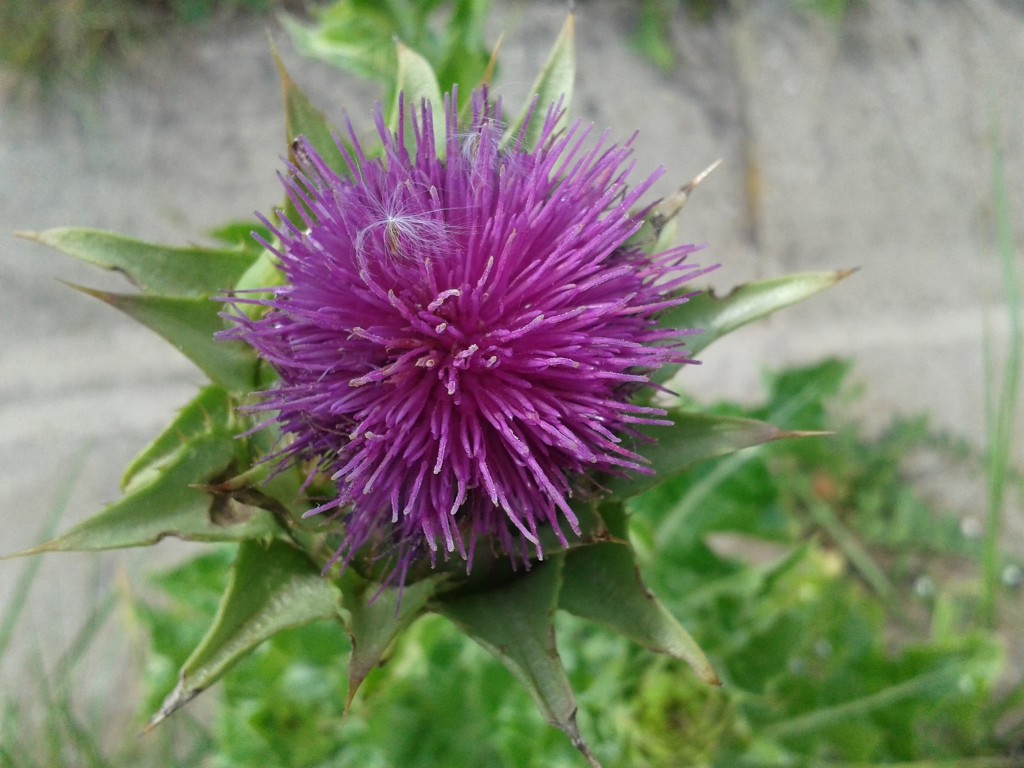
Thistle - photo by A.Bond

Thistle – photo by A.Bond

Last week I posted this photo on Facebook. We have many thistles around our school at the moment and I love their dramatic purple/pink colours. One of my friends commented that these are actually deadly to cows. I am pretty sure she was not suggesting I was a cow, she was simply sharing the information. At the moment I am learning about collection management including how to select books and resources for our collection and of course deselect them – also known as weeding. I realized how conservative I have been in weeding the collection. I think I have been fearful since we are such a distance from sources of books and customs makes it tricky to import them. However, old, musty, dated books are as toxic to our library as purple thistles are to cows.

As I was reading about weeding (now that is fun to say) I found Doug Johnson’s article about it and his comment, “Poorly weeded collections are not the sign of poor budgets but of poor librarianship. Period.” Ouch. That was like coming up against a thistle. But, like so many things, Johnson is right. I have to overcome my fears and get into the collection and get rid of all the weeds. If I don’t my students will not find the great new books we have.

 There are many great guides to how to weed. CREW is a guide from Texas and is downloadable. Then there is the guide from National Library of New Zealand services to schools. Most advice to write a clear collection management policy and set the selection and deselection criteria very clearly. The trouble with weeding is that some people in our schools do not want to part with books. Somehow it can be a very controversial thing to remove books from the library collection. The blog “Awful library books” actually shows the terrible books that librarians are removing form their collections. It also gives some great reasons why we need to weed. In the section “Why weed?” they make the valid point that libraries have limited space. The SCIS electronic newsletter ‘connections’ article about weeding makes the valid point that students actually need materials available ina way that they can easily be found, not crammed together, old and new together.


So yesterday, in the effort to make space at our smallest campus I spent the day weeding the picture books. As I did many children came up to ask what I was doing (as I sat amid piles of old dusty and worn out books). Anna in our Prep class (age 5 years old) sat down beside me and asked if she could help. I told her my criteria for deselecting the books and I handed her an old musty book and asked her what should I do with this? She looked through the book carefully while telling me’ “I haven’t seen anyone look at this book”. After looking at the date due slip, noting the browned pages and ripped spine she said no we shouldn’t re-shelf this book, put it on the pile. Together we worked through about 20 books. Some of the nice looking books we stopped and considered the copyright date (information she grasped quickly and consulted on a few other books). Unfortunately for me Anna had to go to another class and I was left on my own to ransack the picture books.


That day 580 books were removed from our collection. Don’t despair I reordered the tattered favourites and classics. The shelves now show the beautiful new books we have. Children came in and loved browsing the shelves. I have grown stronger in my professionalism as a librarian and yes, though I like the purple thistles they really can be toxic to students use of the collection. I will return and finish the job on the whole collection.

References

Beilharz, R. (2006). Secret library business – part 2. Connections63. Retrieved from http://www2.curriculum.edu.au/scis/connections/issue_63/secret_library_business__part_2.html

Johnson, D. (2003, September). Weed. Retrieved May 17, 2014, from Doug Johnson website: http://www.doug-johnson.com/dougwri/weed.html

Kelly, M., & Hibner, H. (2013). Why we weed. Retrieved May 17, 2014, from Awful Library Books website: http://awfullibrarybooks.net/why-weed/

Larsen, J. (Ed.). (2008). CREW resources and links. Retrieved May 17, 2014, from Texas State Library and Archives Commission website: https://www.tsl.texas.gov/ld/pubs/crew/index.html

Services to schools weeding guide. (n.d.). Retrieved May 17, 2014, from National Library of New Zealand website: http://schools.natlib.govt.nz/school-libraries/building-and-managing-collection/weeding-guide